

What Zohranomics is teaching us (with Jessica Forden)
The economic strength of a people-powered agenda.
Hey there - I’m Matt Hughes, managing editor of Roosevelt Forward’s Fireside Stacks and coauthor of a new report out this week from our sister organization, the Roosevelt Institute—The Good Life Agenda: Fuller Lives, a Stronger Economy, and Renewed Trust.
In his foreword, Paul Krugman puts a fine point on one of the report’s core arguments: “Economics is ultimately about people,” he writes, “and the purpose of economic policy should be to help people live good lives.”
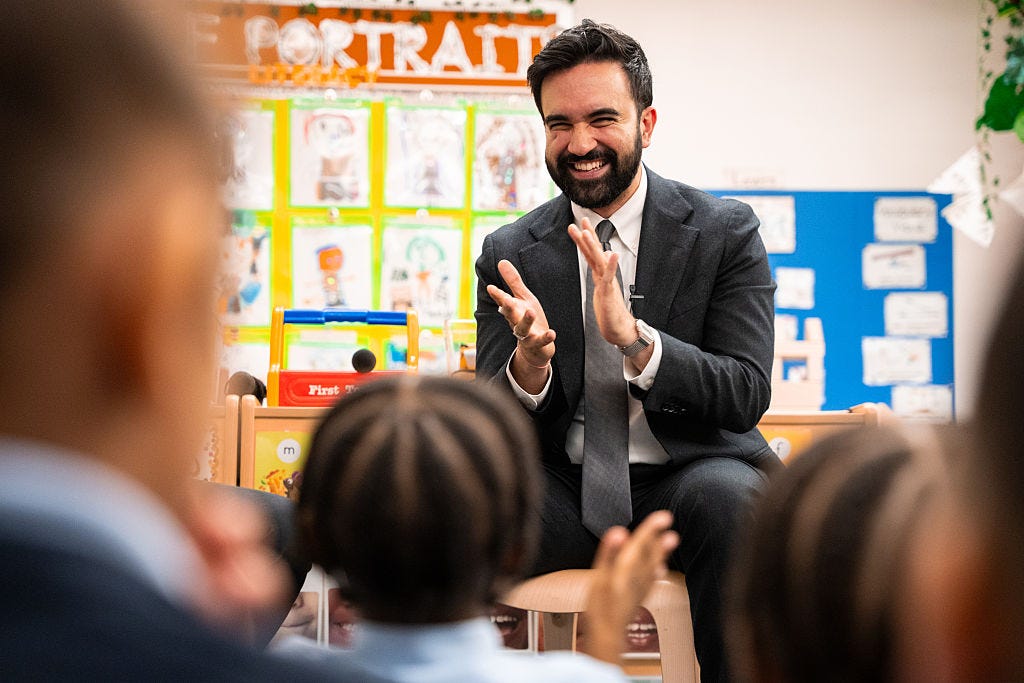
Over the last five months, we’ve seen that principle in action in New York City. Zohran Mamdani’s mayoralty is offering a real-time case study in what people-focused economics can look like, and has delivered early progress on some of New Yorkers’ most urgent demands. Perhaps most notably, we’re getting massive investments in pre-K and 3-K and the launch of the city’s 2-K program, which will deliver full-day, full-year childcare for two-year-olds.
Of course, a lot still needs to be fleshed out as the administration moves from bold policy planks to the nuts and bolts of implementation. That’s what makes this such an exciting moment for progressive economists, and what made a recent convening at The New School so special.
On May 2, the People’s Policy Conference brought together economists, public policy experts, and labor organizers to show how people-centered policy can drive inclusive growth and productivity in New York City. Cosponsored by the Roosevelt Institute, the event also featured members of the Mamdani administration, including Deputy Mayor for Economic Justice Julie Su, Commissioner of the NYC Department of Consumer and Worker Protection Sam Levine, Director of the Mayor’s Office to Protect Tenants Cea Weaver, and Deputy Director for Policy Planning and Delivery at the Office of Management and Budget Nathan Gusdorf.
This week, I chatted with one of the event’s organizers, Jessica Forden—a labor economist who specializes in caregiving and inequality, and the author of an excellent Roosevelt Institute brief from earlier this year, “How Long-Term Care Costs Drain the Middle Class and Deepen Intergenerational Wealth Inequality.”
We talked about the role of economists in a people-powered agenda, the “how do you pay for it” question, and what we’re learning in these early days of Mamdani. Check it out below.
Matt Hughes: All right, Jessica, I’m going to start with a question I already know the answer to, but let’s set the scene for our readers: How did the People’s Policy Conference come to be? What goals did you and your co-organizers have going into this?
Jessica Forden: Yes, it’s so important to start with the context! This conference was originally conceived out of the incredible enthusiasm and excitement of myself and colleagues for Mayor Mamdani’s agenda. What we saw was a policy platform that reflected not only the values that many of us held, but also the economics that we studied. The New School for Social Research has an economics department that is uniquely pluralistic in its curriculum and research.
And so, for us, when we heard the inevitable retort to Mamdani’s policies—that all these things would be nice to have, but were unrealistic to implement for economic reasons—we just knew that wasn’t true. There was a whole body of economic theories and models that folks out of our tradition and history offer that say otherwise.
Progressive urban policies that provide for the public, like universal childcare or fast and free buses, are not only morally desirable but also economically sound and capable of driving inclusive growth.
So, we organized a daylong convening to bring together these economists, public policy experts, and labor organizers to really connect this city agenda to a tradition of economic study that rigorously and, in my view, convincingly shows that such policies are not pie-in-the-sky ideas. In other words, progressive urban policies that provide for the public, like universal childcare or fast and free buses, are not only morally desirable but also economically sound and capable of driving inclusive growth.
The next step is to then do the real intellectual work in bridging the gap between the promise and the implementation, and that’s exactly what we’re hoping to do next. This conference was just a first step.
We’re already looking to next year and thinking about what conversations we might want to have after a year of policy experimentation and implementation from the administration, and in the meantime, we’re planning to draw from the incredibly rich and informative conversations of the panels to develop policy briefs that further explore these policy areas—housing, transit, childcare, and labor.
Matt: I can personally attest that this go-round, and the go-get-’em energy in the room, was a great start. What struck me at times throughout the day was the meta conversation, which sometimes bubbled up to the explicit. You and your co-organizers, and many of the panelists and attendees, are economists by trade. You’re also interrogating what the role of economists even is or should be in a people-powered agenda. Where do you land?
Jessica: Great question. I think historically the role of economists in policy has been to play the role of expert, where we take the traditional economic paradigm as a morally neutral framework with which to assess the “right” or “wrong” policy and its impacts. Under this thinking, economics provides rigor because of the tools we employ in the field, and so policy decisions flow from this expertise.
The people-powered approach flips that script by recognizing an obscured, but important, fact, which is that economics, and consequently its policy assessments and recommendations, is not morally neutral by default. We economists make decisions about the assumptions we bake into our models and how we interpret and apply their results.
As Sam Levine pointed out in the labor panel, some economists point to dynamic pricing as being good because of efficiency gains, but we have to ask who benefits from those gains. If economists prioritize economic efficiency in their policy recommendations, they are implicitly putting forth a values-based argument about what we should prioritize in the economy.
A people-powered approach instead allows the broader populace to make those moral and ethical judgments about what we want to prioritize first. The role of economists then becomes one of providing the rigor that undergirds and informs that socially developed, values-based set of decisions. Economics therefore still provides the important analysis of the trade-offs and effects of policy, but the hidden stage of values-setting happens directly via the people instead of implicitly in the economic analysis, which allows for a better-aligned assessment for how we can shape our economy in ways that better reflect our collective desired outcomes.
Matt: On the topic of desired outcomes—in these early months of Mamdani, we’re seeing a lot of big investments in the affordability of essentials, like childcare. We’re seeing crackdowns on junk fees and unproductive corporate behavior. Perhaps less expected for the mayor’s critics, the administration has answered the “how will you pay for it” question by trumpeting its fiscal responsibility. Mamdani’s balanced budget announcement made a splash, and COGE [Commission on Government Efficiency] might be a jab of a name but is sincere in its focus on making tax dollars go the distance. What did the panelists have to say about this dynamic?
Jessica: People always love to ask that question, “how are you going to pay for it,” when it comes to big, bold policymaking—the implication being that there’s some fixed pot of resources. What the balanced budget announcement, as well as the conversations throughout the conference, really highlighted are the limits of this kind of thinking, not only because it precludes a chance to vision creatively and optimistically, but also because the “how to pay for it” conversation is actually much more nuanced, especially in two ways.
First, we do actually have a lot of resources, not only in this country, but also specifically in New York City. As Deputy Mayor for Economic Justice Julie Su put it, “we are the richest city in the richest country in the world.” The question then is how are we deploying these resources? And that is a fundamentally political, not purely economic, decision. Nathan Gusdorf from the Mayor’s Office of Management and Budget made this point directly in his opening session when he shared that: “It’s not that the city doesn’t have a tax base that is capable of supporting these programs. It’s just that someone has to make a call—are we going to pay for them?”
The constraint isn’t fiscal capacity, but rather what we collectively decide is important and fundamentally a right for New York City’s working class. This is a question about how we structure taxation, what we exempt, and who we ask to contribute.
Second, there are actually many ways we can be creative about paying for things, because there are things we indirectly pay for or don’t realize we are paying for, and what we do currently pay for is not fixed. We can, through policy, shift things to better reflect what we collectively value in our society and community. Adam Tooze from Columbia University and Nathan Gusdorf did a really good job of highlighting this in their discussion of progressive austerity for the opening session.
The constraint isn’t fiscal capacity, but rather what we collectively decide is important and fundamentally a right for New York City’s working class.
Typically, progressives hate the idea of austerity, because it often comes attached with reductions in spending on social welfare programs—especially at the state and local level. The textbook definition of austerity is simply reducing budget deficits, and says nothing about the trade-offs between cutting spending and raising taxes at all. What a progressive austerity approach offers instead is the idea that how we reduce budget deficits does not automatically have to come from cutting spending on social programs. There are actually other levers at our disposal. As Tooze summarized: “A progressive austerity program would consist of a hard look at the distributive consequences of different types of spending through indirect mechanisms.”
In other words, when you have to close budget gaps, it’s crucially important to think about who these policy changes negatively impact the most. Traditional austerity approaches essentially always come at the expense of the working class, framed as, “The people need to take their medicine—it’s unpleasant now, but that’s what will help them be healthy in the long term.”
A progressive austerity approach, as I understand it, would look at the distributional consequences of our spending and budgets first, and instead ask something along the lines of, “Where are we currently spending in ways that don’t match our stated values, especially indirectly through forgone taxes and other revenues?” Those are places where we can plug the leaks to perhaps then afford the policies we do want, and in ways that can balance taxes to better serve the working class. If we had universal childcare where providers got paid enough and parents could afford it, parents wouldn’t have to worry so much, and providers would have enough children in their programs.
Matt: Let’s dig in on those policies. One of the recurring themes of the panels was that we’re traveling this arc from meaty promises to the nitty-gritty of policymaking. And of course, a lot of thorny questions come up as you’re facing choices and trade-offs. Could you walk us through some of those questions?
Jessica: Yes, it was really clear from the housing, transit, and childcare panels that this transition between ideas and implementation brings up a lot of complexity. There are questions of who bears the distribution of the costs and impact of such policies, and how to navigate current infrastructure and systems without replicating the existing inequalities deeply embedded in them. The administration is only about five months in, and so now is the right time to really dig into these types of questions.
Housing, for instance, is a good example of how the distribution question comes up in implementation. Overall, rental income in New York City is well above operating costs, so there’re real margins to lower rents through rent control or freeze programs. But there’s also the issue of how financially leveraged rental owners are. J. W. Mason of CUNY John Jay told us that private landlords are highly leveraged, with around 80 percent of rent income going to servicing debt. Once you slow rent growth, landlords operating under that kind of leverage face financial issues, but tenants might end up bearing the consequences as landlords defer or avoid building maintenance as a means to lower costs. Owners and builders have the market power to essentially “go on capital strike” and “choose not to make repairs,” for example, as Cea Weaver of the Mayor’s Office to Protect Tenants put it. How to go about implementing affordable housing therefore raises questions of how to manage and navigate the financialized structure underneath the city’s housing market, which have real consequences for how costs are borne and passed on.
This also brings us back to that third question, of how to navigate current infrastructure when trying to advance major changes. On the topic of universal childcare, that third panel really engaged in the idea that sometimes expanding current programs simply means replicating existing inequalities and issues currently embedded in the sector. For example, expanding access to childcare has to take into consideration how other home- and community-based childcare providers not included in the pre-K and 3-K, soon to be expanded 2-K system, are displaced, especially those who are in communities of color.
Another way to think about this is how Lauren Melodia of the Center for New York City Affairs highlighted the idea that childcare providers and parents are often pitted against each other in the current private market. Costs are too high for parents, but wages are too low for providers, who are, again, mostly women and women of color. At the end of the day, there needs to be public intervention and more willingness to experiment with pilots and changes to existing infrastructure, especially with practitioner and parent feedback and involvement, rather than just expanding existing programs.
That tension between families and care workers, mediated by an underfunded and fragmented system, is actually a structural feature of how care is organized in this country more broadly, not just in childcare. I recently explored how the same dynamic plays out in long-term care in a piece for the Roosevelt Institute, where rising costs are increasingly captured by private actors while low- and middle-class families are forced to spend down their assets just to age with dignity.
Matt: As you said at the top, this conversation is just the beginning for this People’s Policy project. And the Mamdani administration is still young, so a lot of this story remains to be written. But with conference one in the books, what are you taking away from the day, and what advice would you offer to policymakers trying to make good on the mayor’s vision?
Jessica: To bring it back to Deputy Mayor Su’s fireside chat, I really think the overarching theme of the day was how interconnected economic justice and economic growth truly are. More and better social provisioning of essential goods and services can be in direct service of both goals. As Deputy Mayor Su put it, we should start by asking, “if you wanted economic justice to be the reality, how would you pursue economic growth?” as opposed to starting from a position of economic justice as a trade-off to growth.
Michelle Holder from John Jay pointed out during the labor panel that raising minimum wages has a well-documented fiscal multiplier effect. If you pay workers more, they spend more, because working families put their income back into the local economy. Workers on the lower end of the income distribution in this city are also women, Black, and Latino, so those multiplier effects also are equity effects.
In general, policies that address inequality get more dollars in the hands of working people, which has positive downstream impacts on economies. The transportation panel made this clear too. By connecting workers to jobs, fast and free public transit reduces commute burdens and increases access to housing and childcare.
Deputy Mayor Su raised the example of childcare, noting that federal level paid leave policies and investments in the care workforce, for example, could also create billions in economic activity. To ignore the multiplicative growth effects of policies that put money in working people’s pockets is to ignore the many economic benefits that actually arise out of an economic justice approach.
But designing those interventions intentionally and holistically is really important. We heard from many panels that while abundance-style approaches that focus on increasing supply are important, supply-side interventions alone are not enough. Rather, they should be paired with other interventions.
The housing panel, for example, was explicit that policies to expand the housing stock had to be paired with policies on affordability, like rent stabilization. In the labor panel, this came up as both increasing wages and resourcing the state to ensure enforcement. For example, wage transparency laws provide the state and public with a lot of data and information on gig worker wages, but it’s incumbent upon the state’s agencies, not workers individually, to ensure that their minimum wage is being enforced.
To ignore the multiplicative growth effects of policies that put money in working people’s pockets is to ignore the many economic benefits that actually arise out of an economic justice approach.
This is where the labor movement can particularly play an important role. In the labor panel, Sam Levine made a convincing case for more and continued old-school labor interventions—things like strong wage floors, for example—as a way to combat modern technological interventions in labor markets, namely algorithmic wage and schedule setting.
We need a strong labor sector fighting for these kinds of policies, as well as those explored throughout the day, because these aren’t separate fights. Better economic conditions strengthen workers’ bargaining power, and stronger workers strengthen the coalition that makes better economic conditions possible to begin with.
As Deputy Mayor Su emphasized, unions matter not just for what they win at the bargaining table, but because they’re one of the few remaining institutions capable of diffusing economic power more broadly through society.
Fireside Stacks is a weekly newsletter from Roosevelt Forward about bold economic ideas and the people who put them into motion. If you enjoyed this installment, consider sharing it with your friends.