

The Supreme Court’s Pro-Wealthy Bias Is Growing. Here’s What the Data Says.
This week, we’re bringing you insights from a fascinating study about how today’s Supreme Court is favoring the interests of the ultra-wealthy more than at any point in history. The researchers’ analysis found that over the years, Republican-appointed justices have become more likely to issue rulings that distribute wealth upward.
Andrea Prat is the Richard Paul Richman Professor of Business at Columbia Business School and a professor of economics at Columbia University. Fiona Scott Morton is the Theodore Nierenberg Professor of Economics at the Yale University School of Management and an adjunct professor at Yale Law School. Jacob Spitz is a PhD candidate in the Columbia University economics department and Columbia Business School.
Income inequality in the US has risen over the past several decades. This trend has sparked work trying to pin down the causes, including technology that favors high-skilled workers, globalization and trade that reduce demand for low-wage labor, changes in taxes and benefits, and shifts in education. Importantly, many of these forces are shaped by policy choices, such as tax rules, labor regulations, and opportunities for rent-seeking that tend to benefit those at the top.
While Congress is formally in charge of making federal policy, many scholars point out that the Supreme Court has become a key player as well, using its rulings to interpret or strike down laws and influence public opinion. As Congress has become more gridlocked, the Court’s role has arguably grown.
So, a natural question to ask is: What role does the Supreme Court play in redistributing wealth in the United States, and has that role changed over time?
Narrative accounts claim that the Court’s modern trajectory tends to favor economic elites. Adam Cohen’s book Supreme Inequality argues that, starting in the 1970s, the Court has, with striking regularity, sided with the rich and powerful against the poor and weak. Investigative journalism by ProPublica has tracked the size and frequency of undisclosed gifts given to justices by the rich. Recent empirical work by Epstein and Gulati has documented the increasing “pro-business” tendencies of modern courts, most pronounced in the Roberts Court.
A central challenge for this work is over what exactly to measure. This is an area where the tools of political economy can help.
In our new working paper, published by NBER, we offer a novel approach to build a standard against which to hold the Court’s decisions over time. We build a dataset that codes Supreme Court votes by whether the outcome directly shifts resources toward parties more likely to be wealthy (“pro-rich”) or toward parties less likely to be wealthy (“pro-poor”). We then use the same family of statistical tools that underpin widely used measures of judicial ideology—specifically the Bayesian approach pioneered by Martin and Quinn—but with an explicitly economic interpretation.
The basic descriptive pattern is stark. At the start of our sample, in 1953, Democrat- and Republican-appointed justices voted “pro-rich” in a similar share (40–45 percent) of economically coded, nonunanimous cases. By 2022, the average Republican-appointed justice votes pro-rich about 70 percent of the time, while the average Democratic-appointed justice votes pro-rich about 35 percent of the time.
A New Way to Classify Decisions: Pro-Poor, or Pro-Rich?
Our goal is to avoid labels such as “liberal” or “conservative,” which can be self-fulfilling and time-variable. Instead, we focus on outcomes: who gains resources as a result of a ruling.
Specifically, we restrict attention to direct economic incidence. For example, the wealthiest 10 percent of Americans own roughly 90 percent of publicly traded stock—so if a court ruling allocates resources to shareholders, then it is more than likely to be benefiting the rich.
Conversely, cases that grow the social safety net help the poor: The bottom income quintile receives 28 percent of federal government transfers, compared with 7 percent for the top quintile.
Many cases could also have indirect economic consequences (for example, cutting business regulations may lead to long-run innovation). But those indirect channels can be hard to predict, have varying levels of empirical support, and are subjective, which could distract from what can be concretely understood from case opinions.
By 2022, the average Republican-appointed justice votes pro-rich about 70 percent of the time, while the average Democratic-appointed justice votes pro-rich about 35 percent of the time.
Here’s a concrete example to illustrate our classification system In Massachusetts v. Environmental Protection Agency (2007), the Court allowed the EPA to regulate greenhouse gases under the Clean Air Act. The cost of complying with the Act falls largely on firms (and, through ownership, on shareholders), while benefits accrue broadly to citizens via improved environmental quality. Under our protocol, this is coded as pro-poor, because it shifts surplus away from the (on average) wealthier shareholders and toward the broader public. The aim of our methodology is to extract this information from each case so we can use it to compare justices’ voting patterns over time.
We begin with the universe of 9,341 Supreme Court cases in the Modern Supreme Court Database (1946–2022). Within this, we focus on the post-1953 period during which there are justices from both parties appointed to the Court. We also consider only nonunanimous cases, since it is from the disagreements that we are able to infer justices’ relative positions. This leaves 5,012 cases across 69 years.
We then hired and trained undergraduate and graduate research assistants to read opinions and determine (1) whether a case has direct economic content and, if so, (2) whether the decision directly moves resources from rich to poor or poor to rich. They also had to assign these cases to a “channel” that describes the type of dispute (these include employees vs. firms, customers vs. firms, competition policy, and the social safety net). The resulting dataset contains 1,782 cases classified as having a direct economic impact that is either “pro-rich” or “pro-poor.”
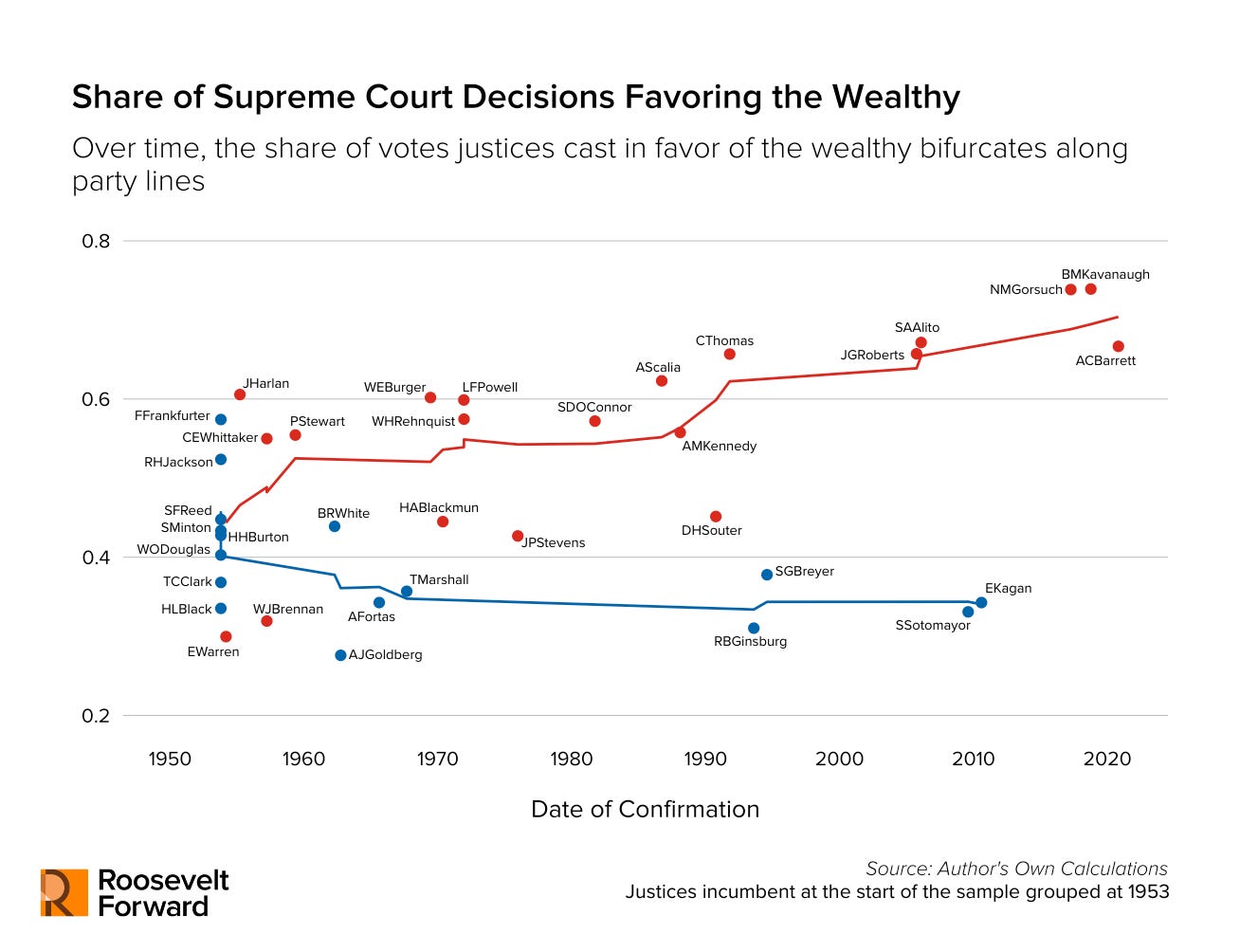
The raw data tells a clear story: Over time, the share of votes justices cast in favor of the wealthy bifurcates along party lines. Importantly, these trends cut across many different types of cases. When we split the raw data using the Supreme Court’s way of categorizing cases by issue area (which include groupings like unions, economic activity, taxation, civil rights, and federalism), as well as by the channels defined by our own categorization, the same polarization pattern shows up in almost all subcategories.
Standardizing and Applying the New Framework
Descriptive statistics, however, have their limits. Justices’ decisions may appear more polarized than they actually are as a result of the changing types of cases that make it to the Supreme Court. To make meaningful comparisons between decades, we need to separate changes in justices’ underlying voting tendencies from changes in the cases they face over time.
To do this, we impose a common scale on the data using a statistical model. In the spirit of Martin and Quinn, we treat votes as revealing latent preferences. In economics, this modeling approach does not require any information about the intent of the justice, or need to know what they consciously or unconsciously considered. The Martin-Quinn method eliminates the need to guess intention and focuses on action.
The advantage of our classification approach is to give that latent dimension a concrete economic interpretation: a justice’s propensity to vote for outcomes that shift resources toward the wealthier parties. The model interprets the information on each justice, case, party, and appointment date holistically, allowing us to recover a consistent measure of how the Court’s center of gravity has moved.
Our model estimates imply that a “typical” justice appointed by the Republican party in 2022 would be expected to vote pro-rich on a neutral case 74 percent of the time, while a “typical” Democratic appointee in the same year would have a 27 percent likelihood of doing so—an implied 47 percentage-point gap. In the 1950s, statistical tests reject the claim that the typical appointees by the two parties were credibly different when it came to the wealth impact of their decisions. By the end of the period, that difference is a near statistical certainty.
The choices of any given justice only tell half the story. The other half concerns the balance of power on the court, determined by the composition of nine justices. In assessing this, we find helpful the concept of the “median justice.” Decisions depend on majorities, and the median justice on a nine-justice Court will find themselves in the majority. Using our estimates, we highlight the median justice during each SCOTUS term.
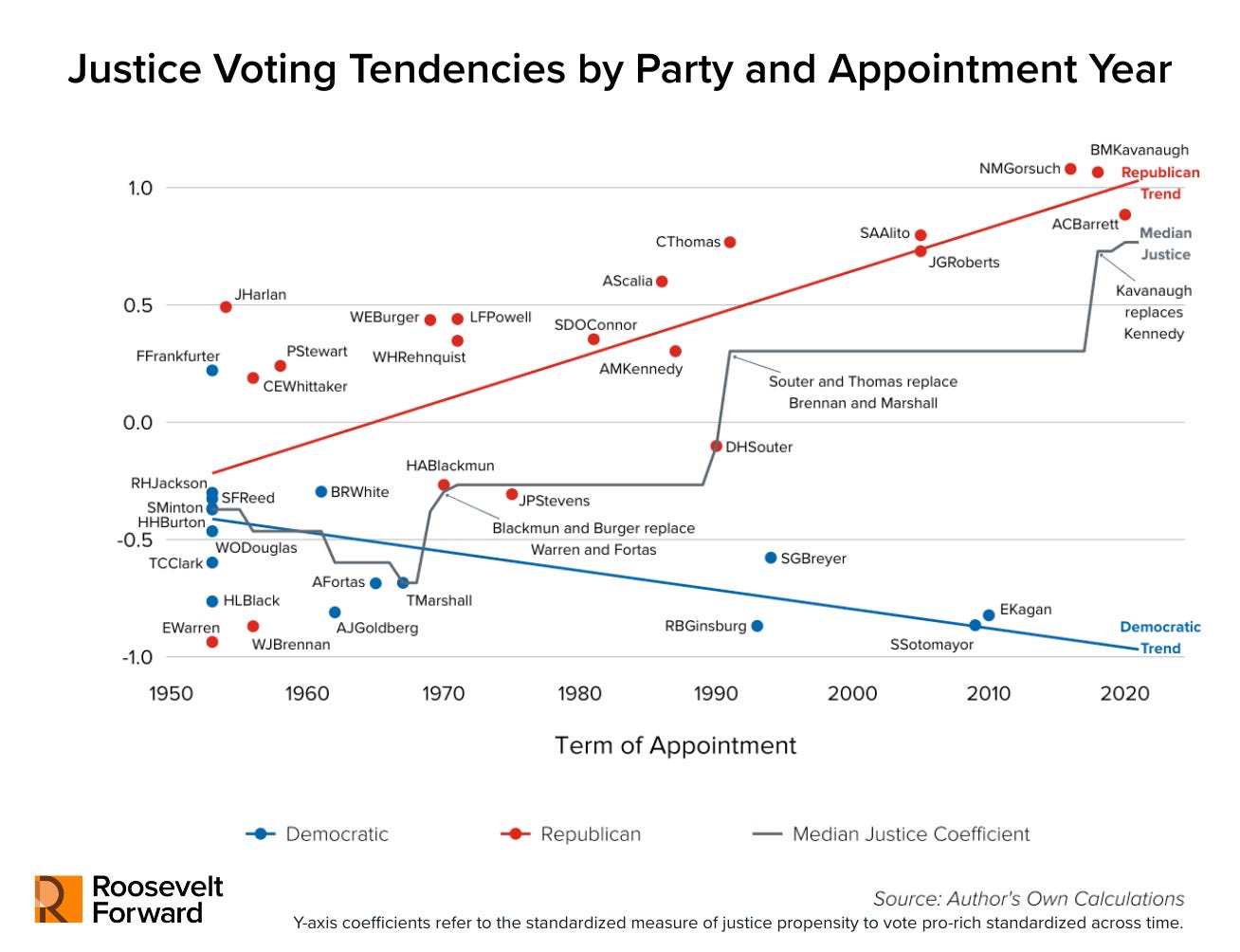
Since the 1969 appointment of Warren Burger, the Republican party has made 15 of the 19 appointments to the Court. Combined with the party trends discussed above, the result has been a shift of the median justice—and thus, the overall makeup of the Court—in a distinctly more pro-rich direction. These shifts are particularly associated with three specific presidents’ decisions: by Richard Nixon in 1969–70, by George H.W. Bush in 1990–91, and by Donald Trump in 2018. Because many economically consequential cases are decided by narrow margins, these shifts in the median justice have meaningful implications for regulation, enforcement, and redistribution.
One reason we think this economic metric is useful to policy audiences is that it may be more predictive for many bread-and-butter cases than labels like “textualism” or “originalism,” which—even in legal scholarship—are often not applied consistently. If the wealthy who have provided gifts to members of the Court also benefit from rulings in their favor, the varieties of legal reasoning that justices use to explain their decisions are not as informative as the material result of their decisions.
Supreme Court Reform—an Economic Policy Issue?
Calls to significantly reform the judicial system are growing. Justices have lapsed in their ethical judgments and accepted hugely valuable gifts; it took an award-winning investigation to finally force the adoption of an ethics code on a court that was previously unique in not having one.
Recent decisions reveal a judiciary unafraid to wrest power away from government administration and toward the courts, as shown in overturning the Chevron doctrine, and with an expansive view of presidential power and immunity that many liken to that of a monarch. In this climate, it is more important than ever to be measuring and monitoring the court.
Our work in this area is explicitly descriptive. We provide a benchmark to understand how the institution has changed over time. What we see today is a Supreme Court that is favoring the interests of the ultra-rich more so than at any point in the past, and a judicial appointment process that has been politically captured. This can help policymakers understand the reality of the Court’s current composition, which is significant when thinking about judicial reform. We contribute to a growing body of evidence justifying a total overhaul.
Fireside Stacks is a weekly newsletter from Roosevelt Forward about progressive politics, policy, and economics. If you enjoyed this installment, consider sharing it with your friends.
 | A guest post by
|
 | A guest post by
|
|