

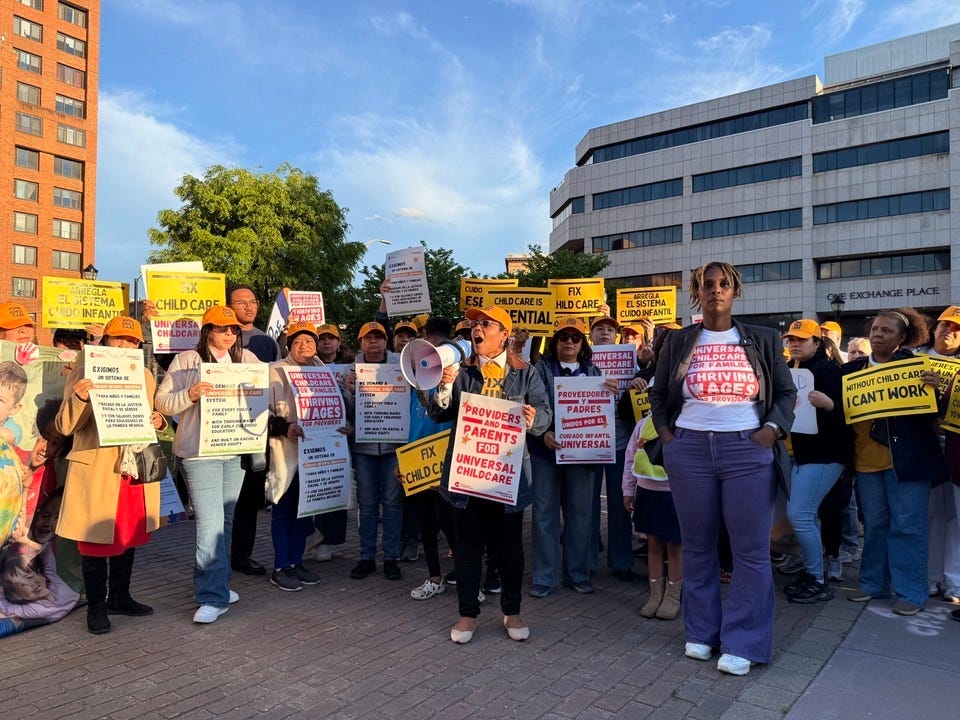
On May 11, childcare providers across the country closed their doors.
It was the fifth annual “Day Without Childcare,” a day drawing attention to the importance of this struggling workforce. Nearly 4,000 people participated in a work stoppage this year, including both providers who closed up shop and parents who joined in solidarity. An even larger number joined rallies, marches, and events in support. And like many such strikes, the organizers were fighting for more than just workers’ wages; their “demand is decisive, organized, and unapologetic: universal child care for all.”
Despite the foundational role that childcare providers play holding up our economy, despite the high level of skill required to care for young children, childcare workers still make poverty wages. This has resulted in massive workforce shortages and a subsequent lack of supply, with half of US families living in a childcare desert. Historical and persistent sexism and racism also keep wages low for childcare workers, 90 percent of whom are female and more than a third of whom are people of color.
Childcare is high-cost and labor-intensive, and its low profit margins provide little space to raise wages for providers without increasing prices beyond what families can afford. Childcare is untenably unaffordable, even exceeding families’ housing costs in most of the country.
The US is long overdue for a massive systemic overhaul of our early childhood system. We need government investment in public, universal childcare, which necessarily requires investing in the workforce to pay childcare providers a thriving wage.
Traditional organizing has long been challenging for this field, for reasons both structural (fragmented workplaces) and systemic (the exclusion of domestic workers from the National Labor Relations Act, for example). But this is shifting in recent years, as childcare workers increasingly organize not only to improve conditions for themselves as workers, but also to fight for childcare for all.
To learn more, I spoke to Tashieanna Smith, a family childcare provider who operates out of her home in Connecticut.
This interview has been edited and condensed for clarity.
Lena Bilik: Nearly 4,000 childcare providers and parents participated in this year’s Day Without Childcare (DWOCC). You were one of those providers. Could you tell me about your experience striking, and how it felt to take this action with so many others?
Tashieanna Smith: It was even more personal this year. In the past, Connecticut has done its own thing—a “morning without childcare”—but this year we decided we were going to be a part of the national Day Without Childcare. Doing it with the whole country really showed me how unified we all are. This year, I hope it’s also showing legislators how unified we are. It’s not just individuals struggling, this is a nationwide thing, with providers unifying as one to take a stand and say: Listen, enough is enough. I think that’s why I felt more passionate and also just SO joyful—I loved it. I would love to transition out of being a childcare provider and be an advocate for all providers, because when I saw the day come to life, I just loved it.
When I heard our usual rally wasn’t going to happen, I said okay, let’s make this happen on the national level. We organized almost 300 providers to come out for the rally after only two weeks of advertising it. Providers groups, every social media site. I sent it to the parents, the parents blasted out texts and emails. When my community needs me, I show up. We only had two weeks to pull it off and we did it, we pulled 300 people out. Can you imagine how many people are going through this, if we could get 300 people in two weeks?
Lena: The childcare provider workforce is a crucial part of the economy—they help parents go to work and they provide incredibly important care and education to our youngest children. Despite this importance, they face low wages, few benefits, and economic insecurity. Can you tell me a little bit about what inspired you to take part in DWOCC?
Tashieanna: Here’s the struggle: We’re not making enough money. And that makes it so hard to deal with all of the regulations and rules, with not enough money. It takes away from the reason we do this job: because we love it. Especially for family childcare providers like myself. It takes away the love of what you do. We are forced to close our doors. I love my job, I’ve been doing this for 18 years, but I want to get out sometimes—because it’s just too hard. Any provider would tell you that, but some of them would be too afraid to speak out and complain. But we need to get paid what we deserve.
To meet the staff ratio requirements, for example, I lose money. I serve nine children at one time. That means I need another staff member. So I overwork myself, and I pay someone else, and I lose money. Right now, we get a range per child—one for $1000 a month (because she is with me 10 am–10 pm), others are $500, or $200, it depends. But in order to make a decent living, you’re working 10 times harder just to make $16 an hour when all is said and done. So those numbers, with working 10 am–10 pm . . . If I worked a minimum-wage job, one job, with less hours, say, at McDonald’s—well, you do the math. I’d be making more. Instead I work 50, sometimes 60 or 65 hours a week, and I make so little.
Lena: Another demand of DWOCC, alongside fair pay for providers, is universal childcare. What would universal childcare for all—a system that would work for families, children, and workers—look like to you?
Tashieanna: I would love to see universal. I have to charge less than the cost to provide care so my parents can make ends meet. But at the end of the day, I have a mortgage, my own children, bills, overhead costs. If we had universal childcare where providers got paid enough and parents could afford it, parents wouldn’t have to worry so much, and providers would have enough children in their programs. And with universal, parents wouldn’t have to deal with [the situation] where if they work a LITTLE bit more, take on a few more hours at work, they can lose their childcare subsidy—even if they need those extra hours at work to pay the water bill, and the car payment, and all of that. Parents often have to think: I need the income from that extra 10 hours of work, but if I do it I’ll lose my childcare and I won’t be able to work at all. Universal childcare would help families AND providers.
If we had universal childcare where providers got paid enough and parents could afford it, parents wouldn’t have to worry so much, and providers would have enough children in their programs.
Lena: What many people may not understand is that childcare programs are not only safe places for children to go so parents can go to work, but they are community hubs that are vital to their neighborhoods. Can you talk a little bit about the role that childcare providers and programs play in their larger communities?
Tashieanna: We are so important. And for family childcare providers, you have to understand—I provide care 24 hours, 6 days a week. I do a first, second, and third shift. I do weekends when needed. We are these families’ therapists, best friends, teachers of their children. We’re the moms of these communities. We provide safe haven for the children, a home away from home while mom or dad has to work. That’s important. We’re the foundation, the backbone. Think about it—when we had a health crisis and everything closed, we said: Listen, if you still have to go to work, we are open. They are our babies. I call them my children.
Lena: How did you see that sense of community show up through the solidarity and support you received from the families you serve to participate in DWOCC?
Tashieanna: The families came out and supported us because they know the sacrifices we make. The families we serve really appreciate it. They actually helped me organize—they told their friends and family about the rally, they helped spread the word. They realize the mental stress providers are under. They want us to get paid. And they know we still smile and do a good job even with this stress. They realize we don’t have sick days. They support us when we call for it.
And we need that support. I knew a family childcare provider who was struggling with so many medical conditions, but she had no papers and no health insurance. She passed away. And through her struggle, she was still showing up for families. They didn’t even know she was sick until she passed. I show up too. I am dealing with my own struggles, and my daughter’s health struggles, and still I show up through all of this. I still show up for my children and families. We still show up. We could easily say, this is too much, let me focus on me and myself. But I know our parents and my children also need me. I’m still here. That’s what family childcare providers do. Parents know that and know how much we show up.
Lena: It’s been so wonderful to talk to you and be able to lift up your story, Tashieanna. Anything else you want people to know about the experience of being a childcare provider?
Tashieanna: Parents can’t pay, and we need more pay. That’s where the Day Without Childcare comes in—it’s just not adding up. The math does not math. That’s why we did this rally, and that’s why we advocate. Some of these 300 providers we organized were new to this kind of thing. They kept just saying, “thank you, thank you for doing this!” And I made sure they got to speak, I highlighted them. I wanted them to see the unity between us all, and that we all want to hear their voices. I might have been the organizer this time, but it wasn’t about me—it was about us.
Fireside Stacks is a weekly newsletter from Roosevelt Forward about bold economic ideas and the people who put them into motion. If you enjoyed this installment, consider sharing it with your friends.