

California is putting billionaires on defense (with Emmanuel Saez)
"Tax the rich" is getting real.
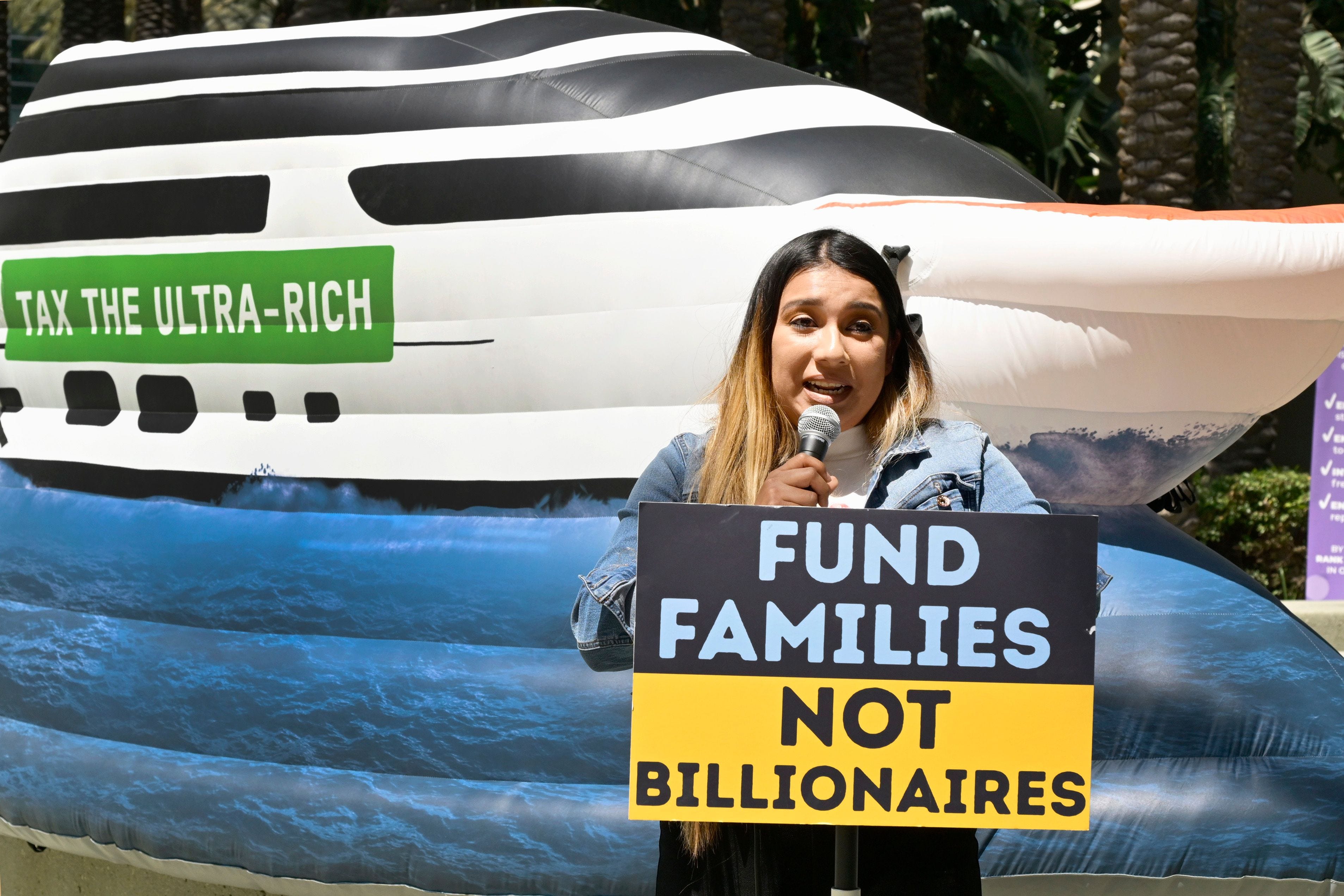
Hi! I’m Noa Rosinplotz, a senior research associate at Roosevelt Forward and coauthor of The Good Life Agenda, a new report out this month from our sister organization, the Roosevelt Institute.
As we wrote there, “The tax code is one of our best tools for restructuring the economy against concentrated wealth and power and toward shared prosperity.” And while federal efforts to tax wealth are farther out of reach, California is giving us a blueprint for what state and local action could look like.
This November, California’s 23 million voters will line up at the polls to vote on a ballot measure that will affect the tax returns of only around 250 of them. While “tax the rich” has taken root as a slogan nationwide, California may become the first US jurisdiction to make it happen on such a scale: The proposal would impose a one-time, 5 percent tax on the entire personal and business net worth of California’s billionaire taxpayers in order to fill the massive, $19 billion-per-year hole in the state budget caused by the healthcare cuts in H.R. 1. The tax is projected to raise $20 billion a year, with 90 percent of the revenue earmarked for healthcare and the rest for education and food assistance.
In the past, wealth taxes have faced thorny design challenges. The ultra-wealthy typically don’t like paying taxes, and they often go to great lengths to avoid them. But the California Billionaire Tax has been carefully designed to avoid many of the pitfalls that have brought down wealth taxes in other parts of the world. For instance, the measure would determine California residency at the beginning of 2026, not the end, so billionaires who move midyear can’t wriggle out of the tax.
I interviewed Emmanuel Saez, professor of economics and director of the Stone Center on Wealth and Income Inequality at the University of California, Berkeley, and co-architect of the proposal, about the design of this tax and what other advocates for state and local wealth taxation should learn from this effort. As a tax nerd, I was very excited to get his take: Saez is also the author of a number of seminal papers on inequality, wealth concentration, and taxation, and it’s rare that a progressive tax paper or bill doesn’t cite his work at least once.
His answers gave me hope for the future of progressive taxation. Whether or not this ballot measure becomes law, it’s already brought much-needed attention to the question of how to tax wealth, and the role of state and local taxes in leading the charge. And even better: For once, billionaires are playing defense.
This interview has been edited and condensed for clarity.
Noa Rosinplotz: Let’s start with some history. In 1978, California’s Prop 13 famously kicked off the tax revolts that have left the US as a low-tax outlier. How did California go from being a first mover in crippling the property tax to possibly a first mover in taxing wealth?
Emmanuel Saez: California is famously known for being a leader in terms of both new technologies as well as policy shifts. It was a first mover on the anti-tax movement with Proposition 13 in response to large property tax increases resulting from a housing boom and rapid inflation.
Today, California is at the epicenter of the tech- and AI-driven billionaire boom at a time when the federal government is cutting funding for healthcare for low-income families. That’s how the initiative came to be.
But unlike Proposition 13, which ushered in the anti-tax Reagan era, the California billionaire tax initiative could usher in a new era in which Americans finally fight back against the unprecedented wealth and power billionaires have amassed.
Noa: As you (and others) have noted, wealth taxes at the federal level could play a valuable role in reducing wealth concentration (or at the very least, reducing its growth) and preventing oligarchy, as well as raising revenue. At the state and local level, how should we think about the purpose of a wealth tax? What changes? Alternatively, what could a wealth tax at the federal level do that a state and local tax can’t?
Emmanuel: At the state level, a wealth tax on the ultrarich can be a significant new source of revenue, especially for states like California that have a lot of billionaires. California billionaires now have a total wealth of $2.3 trillion, nearly three times as much as they had at the beginning of 2023. Hence, even a modest tax of 5 percent on billionaire wealth can bring in substantial new revenue.
We estimate the revenue raised would be around $100 billion, commensurate with the federal funds stripped from California over the next five years.
But modest wealth taxes at the state level cannot solve the problem of soaring wealth concentration. At the federal level, because the ultrarich cannot escape federal taxes (unless they renounce citizenship, and even then they have to pay a stiff exit tax), it is possible to envision much stronger wealth taxes that would apply every year (instead of just once, like the California proposal), of the type Elizabeth Warren and Bernie Sanders proposed in their presidential campaigns in 2019, with tax rates of 5 percent or more each year on the billionaire class.
Such a federal wealth tax could not only raise a lot of revenue in the short run but could also address the problem of wealth concentration in the long run. Billionaire wealth has grown about 5 percentage points faster each year than the economy since 1982. Hence, a 5 percent annual tax is what is needed just to stabilize the growth of billionaire wealth relative to our economy.
Noa: Why is the California proposal designed as a tax on total wealth, rather than, for instance, an increased income tax targeted at the wealthy (as has been recently implemented in Washington state and Massachusetts) or a tax on unrealized gains?
Emmanuel: Billionaires realize very little income relative to their true economic income, let alone their wealth gains. Hence, increasing the tax rates of the existing individual income tax is not an effective way to tax billionaires more.
For California billionaires, we estimate that 80 percent of their wealth is unrealized gains. Therefore for billionaires, a tax on unrealized gains is essentially equivalent to a tax on wealth.
At the federal level, the Biden administration proposed a tax on unrealized gains (the Billionaire Minimum Income Tax), and New York has also proposed a bill to tax the unrealized gains of billionaires in the state. So while a tax on unrealized gains would be more effective than an increased income tax, on a ballot, a wealth tax is easiest for voters to understand.
Noa: Wealth tax proposals at the federal level have used different thresholds to define the ultra-wealthy. Why choose billionaires?
Emmanuel: Billionaires are the group who have experienced the largest increase in wealth and are also the group who pays the least in taxes relative to their true economic income.
They are also a small and very visible group, making it possible for the California tax administration to enforce the tax well.
Noa: This tax is designed as a one-time tax to respond to a particular budget shortfall caused by the 2025 One Big Beautiful Bill Act. What, if anything, would have to change in the design of this tax if it were an annual tax?
Emmanuel: With an annual permanent tax, some billionaires, especially those who are retired and do not need to run their businesses day-to-day, may decide to leave the state to avoid the tax. As a result, an annual wealth tax rate shouldn’t be too high.
However, because billionaires pay so little in individual income tax to start with, adding a recurring wealth tax on top would certainly increase revenue even with mobility responses. Empirical estimates from regional wealth taxes show that a 1 percent annual wealth tax would reduce the wealth tax base by about 10 percent due to mobility responses, leaving 90 percent of the tax base in the state. Hence, moderate annual ultrarich wealth taxes—say, with tax rates up to 1 percent—can still be a valuable permanent source of tax revenue for states.
Noa: I want to dig deeper into one major objection to the proposal: that billionaires will do anything in their power (including leaving the state) to avoid the tax. You and your coauthors have argued that the proposal makes it difficult to escape the tax by moving, given that California residency was established at the beginning of the year, and it’s a one-time tax. (Additionally, as you mentioned earlier, because of how little California billionaires pay in taxes now, the effects of evasion on revenue would be small.) What advice would you give to policymakers who may be thinking about questions of noncompliance in other states or at the national level?
Emmanuel: Indeed, because the ultrarich will exploit any loophole to avoid the tax, it is crucial to design the tax so that it is hard to avoid.
The California ballot initiative achieves this by including a number of strong provisions based on the best lessons we’ve learned from wealth taxes around the world: The wealth tax base is comprehensive with few exclusions, and taxable wealth includes worldwide assets. Therefore, California billionaires cannot avoid the wealth tax by moving their assets outside of California. Owning wealth indirectly through trusts or corporate shells will not reduce valuations for wealth tax purposes. Subsequent sales of assets at prices higher than previously reported will generate ex-post adjustments. There are penalties for underreporting wealth.
At the national level, a country implementing a wealth tax could also impose stiff exit taxes to penalize the ultra-wealthy who want to leave the country to avoid the tax. The US already has such an exit tax for wealthy Americans who want to renounce citizenship, which can serve as a model for other countries.
Noa: If the California ballot measure succeeds, what would you look toward as a measure of its success? (Revenue? Adoption in other states?) What lessons should other wealth tax advocates take from this effort?
Emmanuel: If adopted, the first measure of success will indeed be the revenue collected.
The second measure of success will be the absence of negative impacts on the dynamism of the California tech sector that has created so many billionaires. If the first two materialize, the third measure of success will indeed be adoption by other states and countries.
The lesson so far is that billionaires, no matter how well they do or how little taxes they pay, will intensely resist any tax increase. And they are a very influential group along a very wide spectrum of elected leaders and institutions. This is why pitting people against billionaires through a ballot measure that bypasses the establishment is the best opportunity we have.
Fireside Stacks is a weekly newsletter from Roosevelt Forward about bold economic ideas and the people who put them into motion. If you enjoyed this installment, consider sharing it with your friends.
 | A guest post by
|