

Hi—I’m Todd Tucker, director of industrial policy and trade at Roosevelt Forward.
At RF, we’ve long touted the benefits of public equity stakes in strategically important private companies. Indeed, about seven years before the second Trump administration announced a golden share in US Steel, I had a somewhat pointed piece in Politico pointing out that nationalization might be more effective than whatever the first Trump team thought they were doing.
More recently, Saule Omarova, Lenore Palladino, and I (and additional coauthors) have written longer, sober-er, and scholarly-ier assessments on the topic, including over at our sister org, the Roosevelt Institute—Industrial Policy 2025: Bringing the State Back In (Again) from 2024 and Building Up in 2029: How to Make Green Statecraft Durable from earlier this year.
As the date stamps on those titles hint at, many of us think we’re likely to see more (not fewer) connections between the public and private sectors in the years ahead.
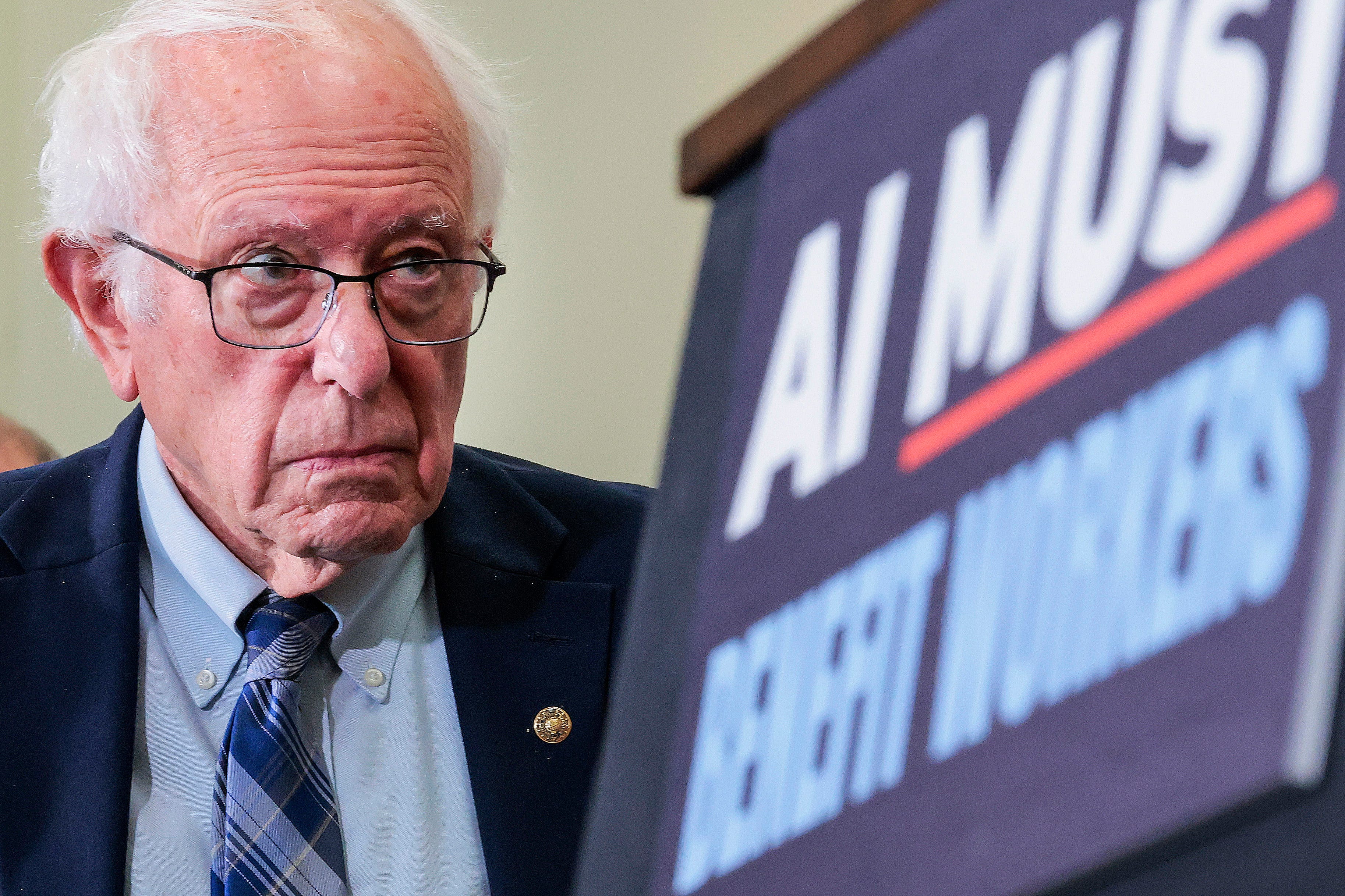
That’s why I was so excited to talk to the brains that helped inspire Senator Bernie Sanders’s latest proposal to take equity stakes in the big AI companies—a move Elizabeth Wilkins and I lauded in The Nation in July.
Here’s my conversation with Jeremy Bearer-Friend of the George Washington University Law School and Sarah Polcz of the University of California-Davis School of Law.
This interview has been edited and condensed for clarity.
Todd Tucker: You’ve gotten a lot of attention for a law review article (“Sharing the Algorithm: The Tax Solution to Generative AI”) that was published last year, in a journal (Columbia Journal of Tax Law) not known for catapulting authors to media stardom. Have you been surprised by the reaction? Can you walk us through the timeline of how and when policymakers and the public started to take notice?
Jeremy Bearer-Friend: I’m a tax professor. I’m not used to people reading my work. But on this project, not only did people read it, but Bernie read it. And apparently he loved it since he made it into a bill.
I think the first time I realized we were really onto something was at the Tax Research Network conference at the University of Cardiff in 2024. I was sharing an early draft of our paper, and it was a standing-room-only audience. That’s not typical!
Sarah Polcz: In summer 2025, I started seeing the news coverage of President Trump taking equity stakes in companies and calling Jeremy to say, “Check this out, he’s totally paving the way for us! He’s going to paint Republicans into a corner on this, public equity stakes are no longer out of bounds for conservatives.”
Our AI equity tax mechanism was new and needed explaining, but the core proposition—making the public key shareholders of large corporations—was surprisingly being embraced by the administration. So then when the [Sanders] bill came out after our article, there was a big public conversation waiting to happen.
Todd: Let’s dig into the meat of the proposal: As you note, in the first year of President Donald Trump’s second term, his administration has acquired equity stakes in around 30 firms, vaulting public equity stakes into mainstream discourse. How similar or different is your public equity stakes proposal to those employed by the Trump administration?
Jeremy: This is something the media keeps getting confused about. Buying shares is so different from taxing shares. Under the Trump plan, more public dollars flow to an industry that’s already been living off of public subsidies. And the public will be losing out even more if the shares end up being worthless. But with an AI tax paid in stock, the public gets shares without handing over a single penny.
Sarah: The shares in President Trump’s deals are mostly nonvoting, meaning there can be an economic gain, but there won’t be a public voice or vote in those boardrooms. The administration did the opposite in the case of President Trump’s US Steel golden share. No financial interest, but the ability to veto major corporate decisions. And under the certificate of incorporation, the veto belongs to Donald J. Trump by name while he is president, not to an independent expert commission. Trump has delegated its exercise to a Commerce official, but the delegation is revocable at his direction.
The common distinguishing factor of Senator Sanders’s bill is the centrality of accountability to the public, which we haven’t seen with this administration’s dealmaking.
Todd: How is this tax proposal different from other tax proposals to address AI—income, excise, and head tax models? Particularly, what are the benefits of a tax paid in equity versus one paid in cash? And do the various proposals do better or worse at addressing the four harms you identify AI could pose to society: the problems of stolen material, labor market disruption, discrimination, and wealth concentration?
Jeremy: Oh gosh, I’m so ready for a race to the top on taxing AI. The more the better. This industry has been getting so much public money, it’s time we all finally got something back!
But I do think it’s worth distinguishing between taxes that really hit the shareholders of these companies versus taxes that are going to get passed on to consumers and workers. With an AI tax paid in stock, the biggest economic impact is on people like Elon Musk and Jeff Bezos.
Sarah: The stolen material problem is painful for a lot of creators. It would be nice to be able to say “now the public, traditional creators included, holds an ownership stake in the companies that appropriated your work, and it doesn’t prevent you from having your day in court for copyright infringement.”
I’m always coming back to the dignity of ownership. It’s a level of recognition that creators and the broader public deserve here, because of the scale of their contributions to AI training, as well as the risk exposure we all face from AI. Other taxes have advantages too, but conferring the social and legal status of ownership is unique to the AI equity tax.
Todd: What criticisms has your and Sanders’s proposal gotten? Did any surprise you, and how have you responded or would you respond?
Sarah: A concern people have raised is that the public might not want to regulate AI companies as thoroughly as they should, if that conflicted with their interests as shareholders. That requires care. One answer is that Senator Sanders’s bill mandates that values like worker welfare and public safety be prioritized over financial returns.
Another concern is that the fund’s assets would be misappropriated or misused. There’s not as much opportunity for that as some may think, since the fund can’t simply turn the shares into cash, and money leaves the fund only for limited statutory purposes, in the first instance paying dividends directly to citizens. There will be a lot of watchful public eyes on that money, which is a good thing.
Jeremy: Well, the surprises have mostly been about the level of support. I think at first we worried it would be called too radical, but 69 percent of the public supports it!
I guess I didn’t expect Trump and Sam Altman would try to co-opt it so fast. Within days of the Sanders 50 percent proposal, Altman was offering a counterbid of 5 percent. So if they meet in the middle, I guess that lands us at 27.5 percent?
Todd: In closing, describe what a successful implementation of your tax proposal would look like. Are there other policies that could be applied alongside your proposal to maximize the public benefit and protect it from the threats of AI?
Sarah: Success to me means Americans feeling comfortably in the driver’s seat for the AI transition; it’s hardly begun, and yet there is some weariness from the sustained sense of urgency and vague peril. The public voice aspects of the proposal, via the commission, have real potential to increase our influence and consequently our ease.
Success is also Americans receiving a dividend and knowing that they’re not getting a handout—they’re getting financial recognition of their dignified standing as co-owners of AI that’s been shaped in ways they’re proud of. Curbing the threats of AI is going to require a global strategy, and I hope to see America supporting international cooperation.
Jeremy: The public is entitled to co-own these companies. Their machines were built by all of us. We all should have an equal share in AI.
Thanks to Roosevelt Forward’s Toyosi Odusola for research assistance.
Fireside Stacks is a weekly newsletter from Roosevelt Forward about bold economic ideas and the people who put them into motion. If you enjoyed this installment, consider sharing it with your friends.